The intelligent optimization platform for resource management
One hardened, multi-tenant core sits behind every resource management use case we solve: aviation and ports today, and the asset-heavy operations that follow. Each new module inherits the same optimizers, audit trail and integration layer on day one, so it ships faster and behaves consistently.
Workspaces
Isolated, branchable environments. Overlay a disruption, a schedule change or a stand closure on the live operation, explore the consequences, then discard the branch or promote it.
Optimizers
A shared library of solver models spanning the combinatorial problems behind stand assignment, gate planning, counter allocation, baggage flows and GSE routing.
AI Agent
A conversational layer across the platform. Interrogate the operation, run scenarios and execute changes in natural language, on the same data, optimizers and audit trail as everything else.
Audit Log
Every change, by every user or algorithm, captured with full context: who, what, when and why. Nothing is silently overwritten and every state is reversible.
Integration
AODB, flight feeds, resource systems, billing, messaging buses and IoT signals connect once at platform level. Every module then consumes one consistent operational picture.
Reporting
A unified analytics layer that turns operational data into KPIs, exports and dashboards, consistent across every module rather than rebuilt for each.
Tags
Cross-cutting metadata that lets you slice the operation by your own dimensions: terminal, alliance, contract, handler, pier or aircraft category, with no bespoke development.
Auth & Tenancy
Organisations, roles and per-planning-horizon access control. Strategic planners, day-of-operations controllers and external handlers each see exactly what they should.

One workspace, every constraint visible
Timeline, conflicts and the agent in a single view
Or run it as an API-only product
Every capability in the platform is available over a documented API. Enterprises that already have their own planning interface, control-room tooling or in-house scheduling stack can consume the optimizers directly and keep their existing UI.
-
Full API documentation. Every endpoint, object and constraint model documented, so your team can build against it without a discovery project.
-
Same guarantees, no UI. Workspaces, tenancy and the audit trail behave identically whether a change arrives from our interface or from your own.
-
Optimization as a service. Post a problem, get a solved plan back, and keep the operational front end you have already invested in.
Optimize request
POST /v1/workspaces/{workspace}/optimize
Authorization: Bearer •••

{
  "module":      "stand-gate",
  "horizon":     "2026-09-03/P1D",
  "constraints": ["adjacency", "tow-windows"]
}

200 OK
{
  "conflicts":  0,
  "assignments": 412,
  "audit_id":   "chg_9f21c4"
}
Illustrative. See the API documentation for the full specification.
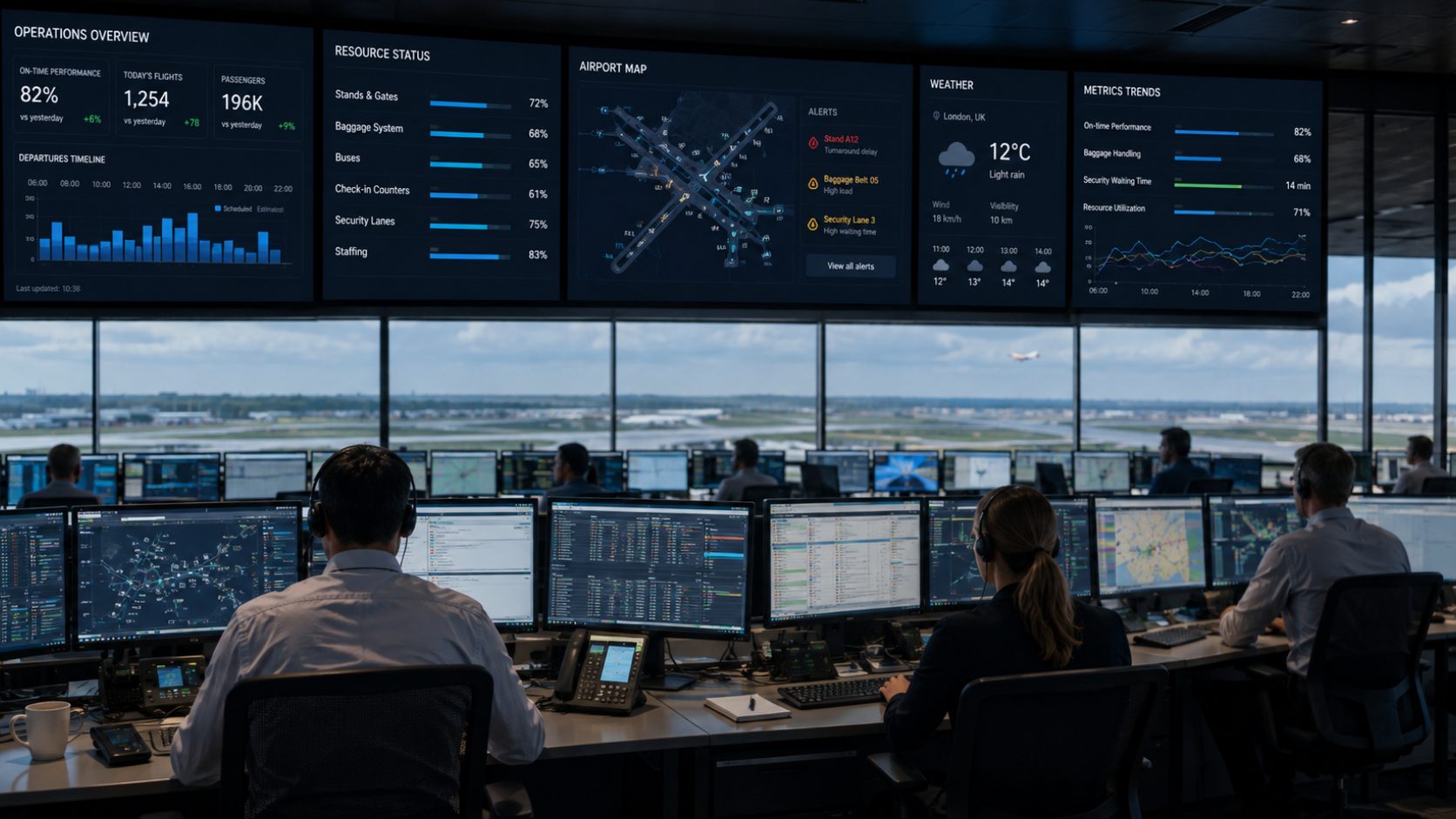
Connect once, at platform level
Aviation operations run on a dense web of upstream and downstream systems. Rather than wiring each module into each system, the integration layer connects once so every module consumes a single, consistent operational picture, and writes back through the same governed channels.
-
Reversible by default. Every state is recoverable, so operational mistakes are undone rather than worked around.
-
Defensible commercially. A complete change history settles disputes with airlines and handlers on the record.
-
Modelled to your reality. Tags let you slice by terminal, alliance, contract, handler or pier without bespoke development.
Discover how much additional capacity you can realize
We will walk you through the platform against your own constraints: stands, gates, counters or tows.